
How RAG Prevents AI Hallucinations
Tools like Notebook, LM, and ChatGPT may all be powered by large language models, but they function in different ways.
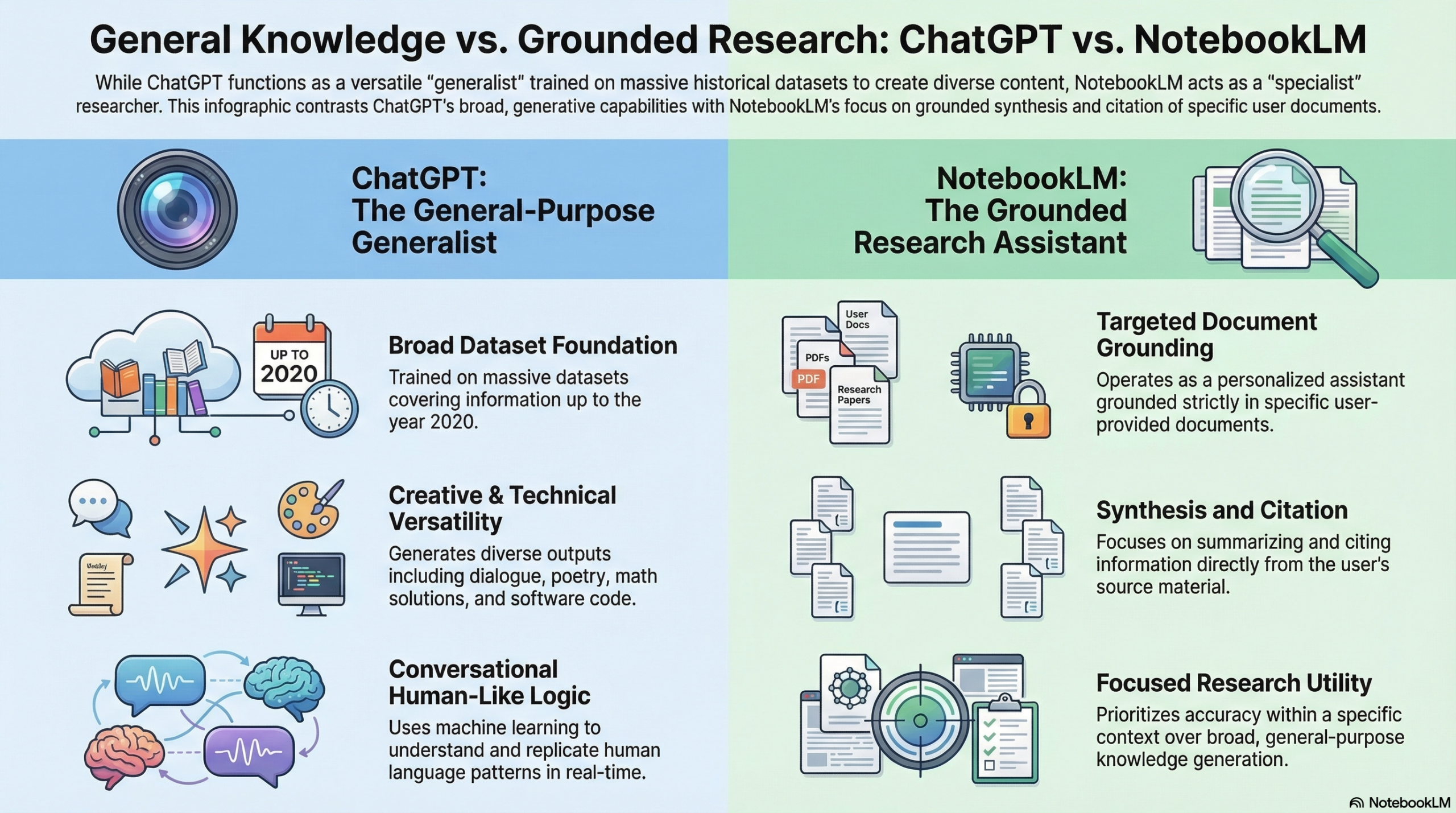
ChatGPT: The “Closed-Book” Conversationalist
- Knowledge Base: It is trained on a massive dataset of text to learn the structure and meaning of language, enabling it to answer questions, solve math, and write creatively.
- Limitations: Its knowledge is limited to what was in its training data (specifically data from 2020 and prior), meaning it may lack understanding of current events.
- Performance: It operates like a “closed-book exam,” where the model must rely on its memory (internal parameters) to answer questions. Because it predicts the “most likely” next word based on patterns rather than facts, it is prone to hallucinations—generating plausible but incorrect information.
NotebookLM (Retrieval-Augmented Generation- RAG): The “Open-Book” Researcher
- Information Grounding: A RAG-based system retrieves facts from an external knowledge base (such as specific documents you upload) to supplement the AI’s internal representation.
- Verification: Unlike general ChatGPT, which often provides answers without clear evidence, a RAG system provides users with access to the original sources, ensuring claims can be checked for accuracy.
- Performance: This is described as an “open-book” approach, where the model responds to a question by “browsing through the content in a book” rather than trying to remember facts from its training memory.
- Current Data: This approach reduces the need to constantly retrain the model on new data; you simply upload the latest documents to update the AI’s knowledge.
As AI tools evolve, the shift from “closed-book” to “open-book” systems marks a significant turning point in how we use language models. While ChatGPT excels at generating ideas, explanations, and creative responses from its broad training, its limitations become clear when accuracy and source verification matter. NotebookLM’s retrieval-based approach changes the dynamic by grounding responses in specific, user-provided documents—prioritizing transparency and evidence over probability. In this sense, the evolution isn’t about which tool is “smarter,” but about which is better suited for the task: imagination and synthesis, or research and verification.
Works Cited
Belcic, Ivan. “What is a Generative Model?” IBM, 2026.
“Chat GPT: What is it?” University of Central Arkansas (UCA) – CETAL, 2026.
“General Knowledge vs. Grounded Research” infographic. NotebookLM, 4 Mar. 2026, notebooklm.google.com/.
“What is the difference between Chat GPT and Notebook LM” prompt. NotebookLM. Large language model, Google, 4 Mar. 2026, notebooklm.google.com/.
Martineau, Kim. “What is Retrieval-Augmented Generation (RAG)?” IBM Research, 22 Aug. 2023